
Gentle Journalling Prompts for Grief
A gentle counselling resource to help you reflect on grief, memories, guilt and the feelings that can be hard to say out loud.
Grief can leave you with more thoughts than you know what to do with.
Some days you might want to talk, but not know who to talk to. Other days you might not want to talk at all, but still need somewhere for the feelings to go. Journalling can offer a small private space for that. You do not have to write neatly, make sense, or find the right words.
These prompts are not here to tidy your grief up. They are simply a place to begin.
A chance to ask questions, see whether we’re a good fit, and decide whether you’d like to work together.

What this resource is for
This resource has been created for anyone who is grieving and would like a gentle way to reflect.
It may be helpful if you are:
- Feeling numb, overwhelmed, guilty or unsure what you feel
- Missing someone and wanting space to remember them
- Carrying thoughts you do not feel able to say out loud
- Trying to make sense of unfinished conversations or regret
- Grieving someone you had a complicated relationship with
You do not need to answer every question. You might choose one prompt and write a few words.
You might look at the page and come back to it another day. That still counts.
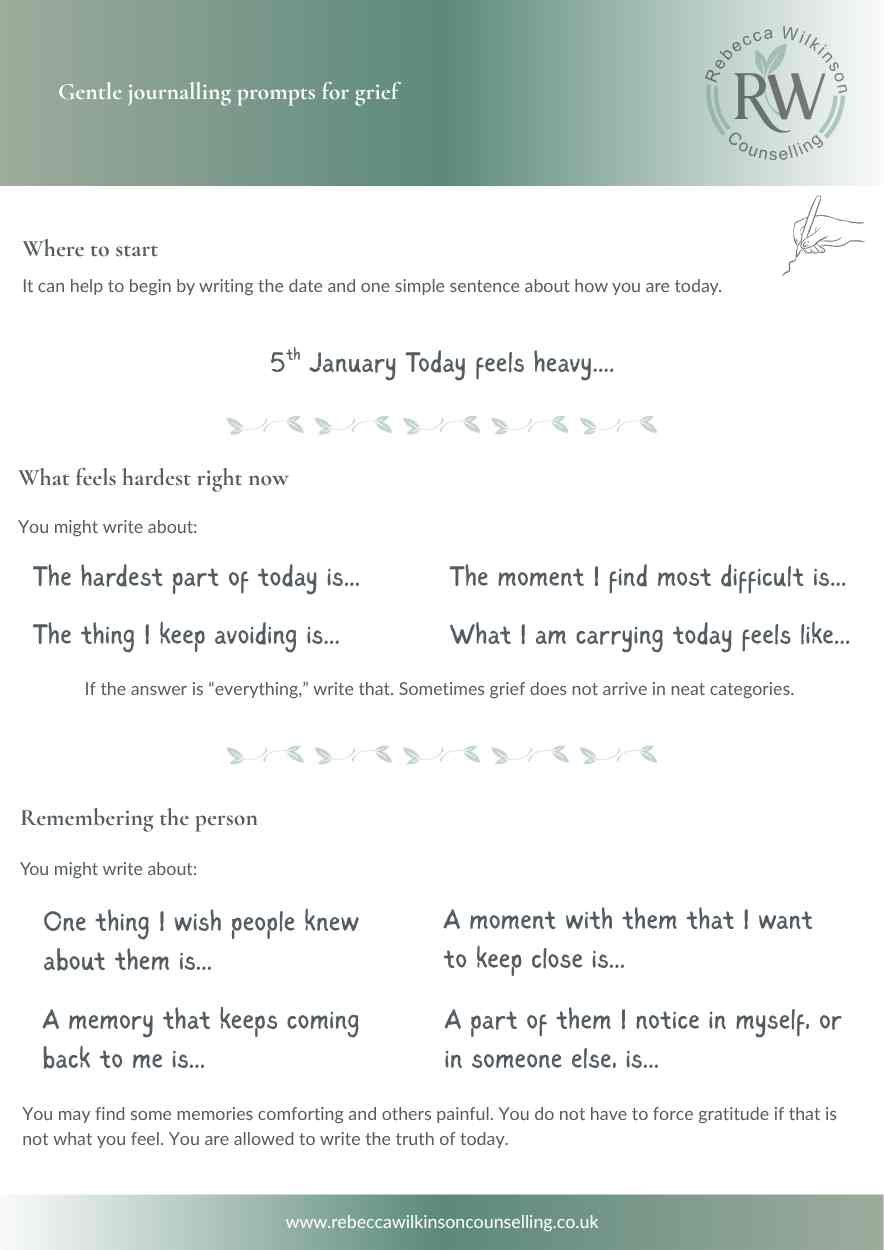
What feels hardest right now
Grief can change from day to day. What felt manageable last week might feel unbearable today. What seemed impossible at first may have become quieter, while something unexpected has started hurting more.
You might write about:
The hardest part of today is…
The moment I find most difficult is…
The thing I keep avoiding is…
Remembering the person
Grief is not only about the moment someone died. It is also about the life they had, the place they held, and the memories that keep appearing in small ways.
You might write about:
A memory that keeps coming back to me is…
Something ordinary I miss is…
A phrase, habit, smell, song, place or object that reminds me of them is…
If the relationship was complicated
Not every loss is simple.
You may be grieving someone you loved deeply. You may be grieving someone who hurt you. You may be grieving someone you felt responsible for, angry with, distant from, close to, or never fully able to understand.
Mixed feelings do not make your grief less real.
You might write about:
The relationship was complicated because…
One thing I miss is…
One thing I do not miss is…
Something I still feel angry about is…
Something I feel sad about is…
Something I wish had been different is…
The version of the relationship other people saw was…
The version I lived with was...
If guilt comes up
Guilt can be one of the loudest parts of grief.
You may find yourself going back over what happened, what you said, what you did, what you missed, or what you wish had been different. These prompts are not about proving you should not feel guilty. They are simply a way to sit beside the guilt and understand what it is holding.
If a prompt feels too painful, leave it. You can come back another time, or not at all.
You might write about:
The guilt I keep coming back to is…
What I knew then was…
What I know now is…
What was actually within my control at the time?
What was not within my control, even if I wish it had been?
If someone I loved felt this guilt, I would want them to know…
What I wish I could say to them is…
What I imagine they might say back is…
After using the resource
When you have finished writing, give yourself a few minutes before moving on.
You might place both feet on the floor, look around the room, take a drink, open a window, or do something ordinary and steady. Writing about grief can leave you feeling lighter, heavier, clearer, tired, or more emotional.
All of those responses make sense.
If you feel very unsettled, it may help to pause and bring yourself back to where you are now. Notice the room. Notice the date. Notice that this is a moment of grief, not the whole of you.
What you’ll find in this resource
- Gentle prompts to help you begin writing when grief feels hard to put into words
- Questions to explore what feels hardest right now, without needing to make sense of everything
- Space to remember the person who died in a way that feels honest to you
- Prompts for guilt, unfinished conversations, and complicated feelings after a loss
When grief feels too much to carry alone
Journalling can be helpful, but it is not the same as having someone with you in it.
If grief feels too much to hold on your own, or if guilt, anxiety, numbness or complicated feelings are becoming hard to manage, you may want to read more about bereavement counselling in Plymouth.
Counselling can offer a private, steady space to talk about loss in a way that does not have to be tidy, polite or easy to explain.
There’s no pressure to continue. Just a conversation.
Further support
You may also find it helpful to read about counselling for anxiety if grief has left you feeling on edge, worried, or unable to settle.
If day-to-day life feels harder to manage since your loss, my page on counselling for overwhelm may also be a useful place to go next.
For those who would rather access support from home, I also offer online counselling.
A final thought
There is no right way to use this resource.
You might answer one prompt, leave most of them blank, or come back to it weeks later. Grief does not move in a straight line, and you do not have to turn it into something tidy before it is allowed to matter.
Start gently. Write what feels true today. Let that be enough.