
A collection of gentle worksheets, journalling prompts and visual resources to help you understand what you are feeling, notice repeating patterns, and take one small step when things feel difficult.
These resources are not a replacement for counselling. They are simply a place to begin.
A chance to ask questions, see whether we’re a good fit, and decide whether you’d like to work together.
If you’re not quite ready for counselling, or you’d simply like somewhere to begin, I’ve created a collection of free resources to support you.
You’ll find journalling prompts, worksheets and practical guides covering topics such as boundaries, self-worth, grief, people-pleasing, perfectionism and grounding techniques.
You don’t have to do everything at once. Small steps still count.
Sometimes the same pattern keeps happening before you have time to catch it.
You might find yourself apologising too quickly, trying to keep the peace, rescuing other people, blaming yourself, or feeling responsible for everyone’s feelings. These resources can help you slow the pattern down and notice what is happening beneath it.
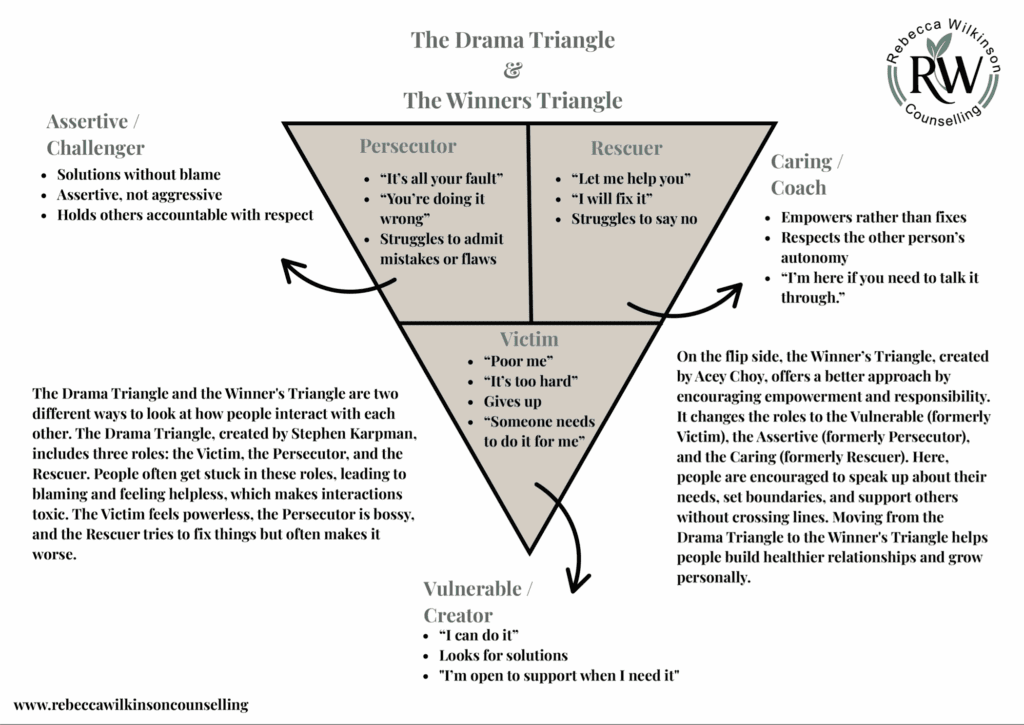
This visual resource explains the Drama Triangle and the Winner’s Triangle. It looks at the roles people can slip into during conflict, including Victim, Rescuer and Persecutor, and how to move towards clearer, healthier ways of relating.
If you often replay conversations afterwards or feel anxious when there is tension, you may also want to read about anxiety counselling in Plymouth.
This resource explores the cycle of perfectionism, including the pressure to get things right, the fear of making mistakes, and the self-criticism that can follow.
It can be a helpful starting point if you often feel driven by pressure, but rarely feel good enough when something is done.

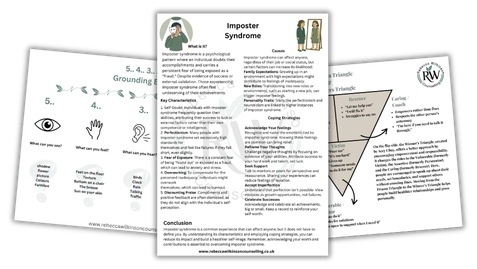
This infographic explains imposter syndrome and the self-doubt that can sit underneath it. It may be useful if you often feel as if you are getting away with things, waiting to be found out, or dismissing what you have achieved.
If self-doubt often comes with anxiety or overthinking, you may find counselling online or in-person helpful.
When your mind gets loud, it can be hard to know what is true and what is fear, shame or old self-criticism talking.
These resources offer simple ways to pause, question unhelpful thoughts, and create a little space between a thought and the way it makes you feel.
This worksheet guides you through a simple process for looking at an unhelpful thought more carefully, almost as if you are weighing up the evidence.
It can be useful when a thought feels convincing, but part of you wonders whether it might not be the truth, the whole truth, and nothing but the truth.
This visual resource explains automatic negative thoughts. These are the quick, unhelpful thoughts that can appear before you have had chance to question them.
It can be useful if your mind often jumps to worst-case scenarios, self-blame, or the feeling that you have done something wrong.
If this is part of a wider pattern of worry, tension or anxiety, you may want to read more about counselling for anxiety in Plymouth.
Grief can be difficult to put into words.
Some days you may want to talk, but not know who to talk to. Other days you may not want to talk at all, but still need somewhere for the feelings to go. These resources offer gentle ways to reflect on grief, memories, guilt and the parts of loss that can be hard to say out loud.
These journalling prompts offer a quiet place to begin writing about grief. They include space to reflect on difficult days, memories, guilt, unfinished conversations and complicated feelings after a loss.
They are not here to tidy your grief up. They are simply a place to begin.
If grief feels too much to carry alone, you may also want to read about bereavement counselling in Plymouth.
Sometimes you need something small and steady.
These resources can help you reflect on what matters, notice your limits, return to the present moment, or begin making sense of how you relate to yourself.
This resource offers gentle prompts to help you reflect on your personal boundaries, including what your limits are, how you know when they have been crossed, and what makes it hard to express them.
It may be helpful if you often say yes when you want to say no, feel guilty for having needs, or find yourself responsible for keeping other people okay.
These prompts are designed to help you reflect on self-worth, self-criticism and the way you speak to yourself.
They may be useful if you often feel not good enough, dismiss your own needs, or find it difficult to recognise what matters about you beyond what you do for other people.
This journalling resource helps you explore your values, how they guide your choices, and where life may have drifted away from what matters to you.
It can be useful when you feel stuck, unsure what you want, or tired of making decisions based mainly on pressure, guilt or other people’s expectations.
This simple grounding exercise can help bring your attention back to the present moment when anxiety, panic or overwhelm starts to take over.
It uses your senses to help you notice where you are now, rather than getting pulled further into the noise in your head.
If anxiety is affecting your day-to-day life, you may want to read more about anxiety counselling in Plymouth.
Some resources may be especially useful if you recognise ADHD traits, task paralysis, emotional intensity, masking, or the feeling that ordinary tasks take far more effort than people realise.
You may find the grounding exercise helpful when everything feels too much. The values prompts may help if you feel disconnected from what matters to you. The boundaries prompts may be useful if you often overcommit, people-please, or lose track of your own needs.
If this connects with your experience, you can read more about ADHD counselling in Plymouth.
Choose the resource that matches what feels loudest today.
If your thoughts are racing, try the grounding exercise or the automatic negative thoughts resource.
If you are grieving, start with the grief journalling prompts.
If you keep getting pulled into the same relationship patterns, try the Drama Triangle or boundaries prompts.
If you feel stuck, self-critical or unsure what you need, the self-worth or values prompts may be a gentle place to begin.
You do not need to work through everything. One page, one prompt, or one small moment of noticing can be enough.
If a resource brings up something that feels difficult to hold alone, counselling can offer a steadier place to talk it through. I offer counselling in Plymouth, Plymstock and online, with support for anxiety, bereavement, ADHD traits, overwhelm, people-pleasing, burnout and self-doubt.
You are welcome to book a free initial call if you would like to ask questions or see whether working together feels right.
There’s no pressure to continue. Just a conversation.