
The Drama Triangle Explained
A gentle counselling resource to help you understand repeating patterns in relationships, conflict and communication.
A chance to ask questions, see whether we’re a good fit, and decide whether you’d like to work together.
Patterns in communication
One person feels blamed. Another person rushes in to fix things. Someone else withdraws, criticises, apologises too quickly, or ends up feeling responsible for everyone’s feelings.
It can feel as if the conversation has taken on a life of its own. You may start with one small issue, then suddenly find yourself in a familiar place: defensive, guilty, resentful, overwhelmed, or trying to keep the peace.
The Drama Triangle is one way of understanding these patterns. It is not about labelling anyone as the problem. It is about noticing the roles people can slip into when stress, fear, guilt or conflict take over.
This free resource explains the Drama Triangle and the healthier shifts that can help you step out of old patterns with more awareness.
What is the Drama Triangle?
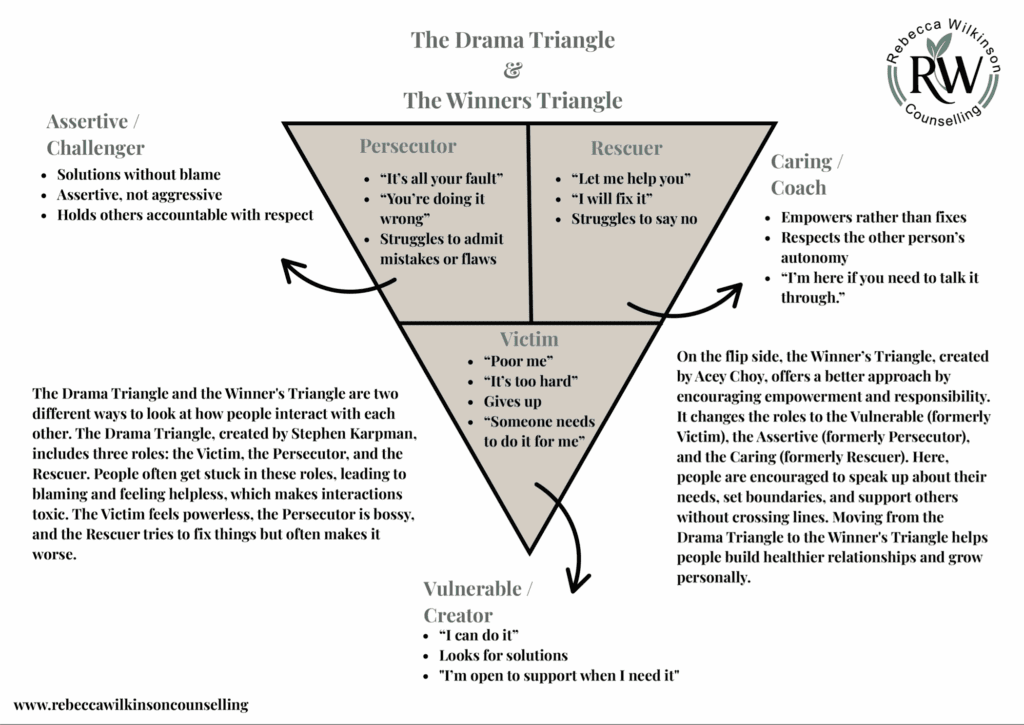
The Drama Triangle was developed by Stephen Karpman to describe three roles that often appear in moments of tension or emotional stress: Victim, Rescuer and Persecutor.
These words can sound harsh at first. They are not meant as insults.
In this model, the Victim role is the part that feels powerless, stuck or unable to choose. The Rescuer role is the part that tries to fix, soothe or take responsibility for someone else. The Persecutor role is the part that criticises, blames, controls or pushes.
Most people do not sit in one role all the time. The roles can shift quickly, sometimes even within the same conversation.
You might begin by rescuing, then feel resentful when your help is not noticed or appreciated. You might then become critical, or collapse into feeling unvalued and powerless. Someone else may then step in to rescue you, and the pattern continues.
That is why it is called a triangle. People can move around it without realising.
How the Drama Triangle can show up in everyday life
The Drama Triangle often appears in ordinary moments, not just dramatic ones.
It might show up in a family conversation where one person is upset and everyone else rushes to calm things down. It might appear in a relationship where one person feels they have to manage everything, then feels resentful when nobody notices. It might happen at work when someone takes on too much, feels unsupported, and then becomes short or critical.
It can also show up quietly.
You might say yes when you want to say no. You might feel responsible for someone else’s mood. You might avoid saying what you really think because you do not want to cause conflict. You might feel guilty for having needs. You might find yourself apologising just to make the tension stop.
These patterns are often learned. They may have helped you cope in the past, especially if keeping the peace, reading the room, or looking after others became a way to feel safe.
The problem is that patterns that once protected you can later leave you feeling trapped.

The three roles
The Victim
The Victim role can sound like:
“I can’t”
“There’s nothing I can do”
“This always happens to me”
This is not the same as being harmed or genuinely struggling. In the Drama Triangle, this role describes a place where someone feels powerless and unable to see their choices.
The Rescuer
The Rescuer role can look kind from the outside. It may involve:
Helping
Fixing
Advising
or taking responsibility for someone else’s feelings. The difficulty is that rescuing often comes with a cost. You may end up exhausted, resentful, or quietly hoping someone will notice how much you are carrying.
The Persecutor
The Persecutor role is the part that blames, criticises, controls or attacks.
This may be directed at someone else, or it may be turned inward. Sometimes the harshest persecutor is the voice in your own head telling you that you are selfish, too much, not enough, or always getting it wrong.
The point of this model is not to decide who is the Victim, who is the Rescuer, and who is the Persecutor forever.
The point is to notice when a pattern has started.
Why these patterns can feel so hard to step out of
It can be painful to realise how often you are pulled into the same role.
You may notice that you often rescue people, then feel invisible. You may notice that you go quiet and feel powerless when someone is upset with you. You may notice that when you feel scared or unheard, you become sharper than you mean to be.
Sometimes the pattern is not only about the other person. It is also about what happens inside you.
You might replay the conversation afterwards and wonder whether you said the wrong thing. You might feel anxious when there is tension, even if nobody has done anything especially terrible. You might try to prevent conflict before it even starts.
If this sounds familiar, you may find my page on anxiety counselling in Plymouth helpful.
The Drama Triangle and people-pleasing
The Rescuer role can be especially familiar if you have spent a long time trying to keep other people okay.
You might notice what others need before you notice what you need. You might offer help before anyone asks. You might step in quickly when someone is upset, not because you are doing anything wrong, but because their discomfort feels hard to sit with.
Over time, this can become exhausting.
You may start to feel resentful, unseen, or responsible for things that are not really yours to carry. Then guilt can appear. You may tell yourself you are selfish for wanting space, or harsh for needing a boundary.
This is where the Drama Triangle can be useful. It can help you notice the difference between support and rescuing.
Support leaves room for both people to have responsibility. Rescuing often leaves one person carrying too much.
You may also find my boundaries journalling prompts useful if saying no, naming your needs or recognising your limits feels difficult.
When emotions arrive quickly
For some people, these patterns can feel especially hard to step out of because emotions arrive fast.
A change in tone, a short reply, a look, or a small criticism can feel huge. Before you have had time to think, you might already be apologising, defending yourself, fixing something, shutting down, or feeling convinced that you have done something wrong.
This can be particularly familiar for people with ADHD traits, especially around emotional intensity, rejection sensitivity, masking and people-pleasing.
That does not mean every difficult relationship pattern is because of ADHD. It simply means that if your feelings arrive quickly and strongly, it can be harder to pause before the old role takes over.
If that connects with your experience, you may want to read more about ADHD counselling in Plymouth.
When grief brings old roles to the surface
Loss can bring family roles into sharper focus.
One person may become the fixer. Another may feel blamed. Someone else may withdraw, take control, keep everyone else going, or feel unable to say what they really need.
Grief can make these patterns more painful because everyone is already under strain. People may cope in very different ways. Some want to talk. Some avoid talking. Some organise. Some fall apart. Some become irritable or controlling because they feel helpless underneath.
The Drama Triangle can help make sense of this without turning anyone into the villain.
It can also help you notice what role you are being pulled into, especially if you are grieving while also trying to manage everyone else’s feelings.
If this connects with your experience after a loss, you can read more about bereavement counselling in Plymouth.
Moving out of the Drama Triangle
The aim is not to never fall into these roles again.
That would be a lot to ask of any human being.
The aim is to notice sooner.
When you notice you are rescuing, you may be able to pause and ask, “Is this mine to fix?” When you notice you feel powerless, you may be able to ask, “What choice do I still have here?” When you notice blame or criticism rising, you may be able to ask, “What am I really trying to protect?”
Small shifts matter.
Instead of rescuing, you might support. Instead of collapsing into powerlessness, you might name what you need. Instead of blaming, you might speak more directly about what has hurt or frightened you.
This does not mean becoming cold, selfish or detached.
It means relating with more honesty, clearer responsibility, and less automatic self-abandonment.
Why this can matter in counselling
Counselling can help you slow these moments down.
Instead of only looking at the argument, we can look at what happens underneath it. What are you afraid will happen if you say no? What do you feel responsible for? What do you do when someone seems disappointed in you? What happens in your body when conflict begins?
This is where the Drama Triangle can be useful. It gives language to patterns that can otherwise feel messy, confusing or impossible to explain.
It can also help you move away from blame.
Not “What is wrong with me?”
Not “What is wrong with them?”
But “What pattern are we caught in, and what might help me step out of it?”
That question can change the shape of a conversation.
Free Resources
If you’re not quite ready for counselling, or you’d simply like somewhere to begin, I’ve created a collection of free resources to support you.
You’ll find journalling prompts, worksheets and practical guides covering topics such as boundaries, self-worth, grief, people-pleasing, perfectionism and grounding techniques.
You don’t have to do everything at once. Small steps still count.
What you’ll find in this resource
- A simple visual guide to the Victim, Rescuer and Persecutor roles
- Everyday examples of how the Drama Triangle can show up in relationships
- A gentler look at how to move towards clearer, healthier communication
- Reflection prompts to help you notice your own patterns without blaming yourself

You can download the free Drama Triangle resource below and use it in your own time.
You might find it helpful to read it slowly and notice which parts feel familiar. You do not need to force an answer straight away. Sometimes the first step is simply recognising, “This is the pattern I keep getting pulled into.”
Further support
If this resource has helped you recognise patterns that feel hard to manage alone, counselling can offer a steadier place to explore them.
You might want support with anxiety, people-pleasing, emotional intensity, grief, conflict, boundaries, or the feeling that you keep ending up in the same role with different people.
If you are not sure what kind of support would fit, you can read more about how counselling works before getting in touch.
There is no pressure to have it all worked out. Sometimes noticing the pattern is the first honest step.
There’s no pressure to continue. Just a conversation.